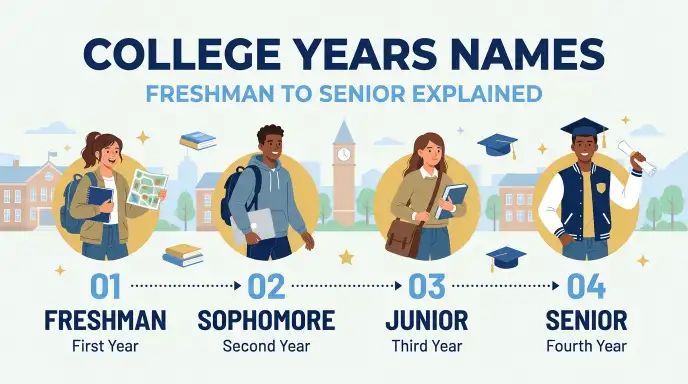
College years names are the four titles used for each year of undergraduate study: freshman (first year), sophomore (second year), junior (third year), and senior (fourth year).
These names are most common in the United States and Canada. Each title shows how far a student has progressed in their degree, and they are used in schools, on campuses, and in everyday conversation.
The words have interesting origins. “Freshman” means someone new to college, “sophomore” comes from Greek words often linked to “wise fool,” and “junior” and “senior” simply mean younger and older.
Other countries use different terms. In the UK, Ireland, and Australia, students usually say “first-year,” “second-year,” and “third-year” instead, and the words freshman and sophomore are rarely used.
In this article, we will explore what each year of college is called, where each name comes from, and how the terms differ around the world. Whether you are a new student, a parent, or a writer, this guide will give you a clear and simple answer.
Defination:
College years names are the titles for each year of college: freshman, sophomore, junior, and senior.
What Are the Four College Years Called?
The Four Traditional College Year Names
In the United States, a typical four-year undergraduate program uses four traditional names:
- Freshman: First year of college.
- Sophomore: Second year of college.
- Junior: Third year of college.
- Senior: Fourth and usually final year of college.
These labels describe a student’s academic standing, not their age. A student may enter college at a different age, transfer from another institution, or take extra time to complete a degree.
| College year | Traditional name | Student’s stage |
| First year | Freshman | Beginning college |
| Second year | Sophomore | Continuing studies |
| Third year | Junior | Advanced undergraduate study |
| Fourth year | Senior | Usually completing the degree |
Do All Colleges Use These Names?
No. Although these four terms are common in the United States, colleges may use different systems. Some institutions use first-year student, second-year student, and similar labels because they are clear and inclusive.
The terms can also depend on completed credits rather than the number of calendar years a student has attended college. For example, a transfer student may enter a university with enough credits to be considered a junior.
Freshman: The First Year of College:
What Does Freshman Mean?
A freshman is traditionally a student in the first year of college or university in the United States. This stage often includes adjusting to a new learning environment, meeting classmates, and learning how college courses work.
Freshmen may attend orientation sessions, join clubs, explore campus facilities, and begin choosing subjects related to their intended major.
Example: “My sister is a freshman at college this year.”
Alternative Names for First-Year Students
The word freshman is widely recognized, but some schools prefer first-year student. This alternative is useful when you want wording that is simple, neutral, and appropriate for different audiences.
Other informal expressions include new student and college newcomer. These are descriptions rather than official academic classifications.
Sophomore: The Second Year of College:
What Does Sophomore Mean?
A sophomore is traditionally a second-year college student in the United States. By this stage, students often have more experience with college life and a clearer idea of their academic interests.
Sophomores may complete introductory courses, explore majors, and begin studying subjects that relate more closely to their future careers.
Example: “He became a sophomore after completing his first year.”
Why Is Sophomore a Unique College Term?
Unlike first-year student or second-year student, the word sophomore is a traditional label that does not directly state the year number. Its historical development is associated with older educational terminology.
Students do not need to memorize a special meaning beyond its usual academic use: sophomore means a student in the second year.
Junior: The Third Year of College:
What Does Junior Mean?
A junior is traditionally a third-year undergraduate student in the United States. Juniors have often completed much of their introductory coursework and are moving toward more advanced classes.
This stage may involve internships, research projects, career planning, or preparation for graduate school. However, these activities depend on the student’s program and institution.
Example: “She is a junior majoring in biology.”
Is a Junior Always in the Third Calendar Year?
Not necessarily. Colleges may classify students according to credits earned or academic progress. A student who transfers credits from another school might be considered a junior without having spent three full calendar years at that institution.
Therefore, the official classification used by the college is more reliable than counting years alone.
Senior: The Fourth Year of College:
What Does Senior Mean?
A senior is traditionally a fourth-year undergraduate student in the United States and is often approaching graduation. Older people may finish major requirements, complete final projects, apply for jobs, or prepare for further study.
Example: “My brother is a senior and will graduate in May.”
Is Senior the Final College Year?
In a typical four-year undergraduate program, senior year is usually the final year. However, not every degree follows a four-year structure. Some programs take longer, and students may need additional semesters to meet graduation requirements.
For this reason, senior generally refers to academic standing rather than guaranteeing that a student will graduate at a particular time.
College Years Names in Order:
Quick Comparison of Freshman, Sophomore, Junior, and Senior
The following table makes the traditional order easy to remember.
| Order | Name | Simple meaning | Common next step |
| 1 | Freshman | First-year student | Continue to year two |
| 2 | Sophomore | Second-year student | Continue to year three |
| 3 | Junior | Third-year student | Complete advanced coursework |
| 4 | Senior | Fourth-year student | Finish degree requirements |
Easy Way to Remember the Order
Think of the names as a four-step path:
Freshman → Sophomore → Junior → Senior
A freshman begins college, a sophomore moves into the second year, a junior enters the third year, and a senior is usually near graduation.
Keep in mind that these labels are most closely associated with American education. If you are studying in another country, the official year names may be different.
College Year Names in the USA vs. the UK:
How American and British College Terms Differ
The words college and university do not mean exactly the same thing in every country. In the United States, college often refers to undergraduate education, while in the United Kingdom, the word can describe several different types of educational institutions.
American students commonly use freshman, sophomore, junior, and senior. In the UK, students generally refer to their university stage by its year number, such as first year, second year, or final year.
| Academic stage | Common US term | Common UK term |
| First year | Freshman | First-year student |
| Second year | Sophomore | Second-year student |
| Third year | Junior | Third-year student |
| Fourth year | Senior | Fourth-year or final-year student |
Are College and University Years the Same?
The terms depend on the country and the program. In the United States, a bachelor’s degree commonly takes four years, although some students finish sooner or later. In the UK, many bachelor’s programs take three years, while some take four years or longer.
As a result, a British student in the third year may be in the final year of a typical three-year degree. Meanwhile, an American student in the third year is traditionally called a junior.
Other Names Used for College Students:
Formal and Informal Alternatives
Not everyone uses traditional college year names in everyday conversation. The best term depends on if you are writing an academic document, speaking casually, or creating content for a student audience.
- First-year student: A clear alternative to freshman.
- Second-year student: A direct alternative to sophomore.
- Third-year student: A direct alternative to junior.
- Fourth-year student: A direct alternative to senior.
- Undergraduate: A student working toward a bachelor’s degree or another qualification below a graduate degree.
- Transfer student: A student who moves from one college or university to another.
- Graduate student: In the United States, a student pursuing education after completing an undergraduate degree.
- Final-year student: A student in the last year of a particular program.
Which Term Should You Use?
For formal writing, follow the official classification used by the college. For general readers, labels such as “first-year student” are clear and easy to understand. In casual American conversation, the traditional four names are also widely recognized.
Creative College-Themed Names for Student Groups:
Funny College Group Names
If you are searching for college years names for a group chat, classmates, roommates, or a campus activity, you may want something more playful than an academic label.
Here are some original, informal ideas:
- The Lecture Legends
- Campus Chaos
- The Study Breakers
- Coffee Before Class
- The Deadline Dodgers
- Dorm Room Dreamers
- The All-Nighters
- Books and Banter
- The Campus Crew
- The Homework Heroes
- The Snack Scholars
- The Attendance Survivors
These are creative suggestions, not official college classifications or established organization names. Before using one for a public group or organization, check if another group already uses it.
Names for Different College Stages
You can also choose a group name that reflects a student’s year.
- Freshman group: The New Beginnings, First-Year Friends, Campus Starters
- Sophomore group: The Second-Year Squad, Growing Scholars, The Campus Explorers
- Junior group: The Junior Journey, Career Starters, The Rising Scholars
- Senior group: The Final Chapter, Graduation Bound, The Legacy League
These names work best for informal activities, class groups, social media, and college-themed projects. They should not be confused with the formal academic labels used by a university.
How to Choose the Right College Year Name:
Consider the Purpose
Before selecting a name, decide what you need it for. A name for an academic article should be accurate and easy to understand. A group chat can use humor, wordplay, or references to campus life.
For example, first-year student is suitable for formal writing, while The New Beginnings might work for a freshman group chat.
Match the Name to the Audience
Consider who will read or use the name. American readers will generally recognize freshman and sophomore, but international readers may find numbered labels clearer.
If your audience includes students from several countries, use the academic year number and explain the local terminology where needed.
Keep the Meaning Clear
Avoid names that imply an official status when the group does not have one. For instance, a student group called Senior Scholars might sound like an official academic program, depending on its context.
For general content, clarity matters more than clever wording. Use traditional terms for academic stages and creative names for informal groups.
FAQs:
1. What are the four years of college called?
In the United States, the four traditional undergraduate years are called freshman, sophomore, junior, and senior. They usually represent the first, second, third, and fourth years of study.
2. Is a freshman in the first or second year?
A freshman is traditionally a first-year college student. A sophomore is a second-year student.
3. What is a third-year college student called?
In the United States, a third-year undergraduate student is traditionally called a junior. However, the student’s official classification may depend on completed credits.
4. What is the last year of college called?
The last year of a typical four-year undergraduate program in the United States is called senior year. In other countries, students may simply call it the final year.
5. Are freshman and first-year student the same?
Yes, they generally refer to the same stage of college in the United States. However, some institutions prefer first-year student as a more inclusive alternative.
6. Do all countries use freshman, sophomore, junior, and senior?
No. These terms are especially common in the United States. Other countries often use numbered academic years, such as first year, second year, and final year.
7. What are some funny names for college students?
Informal options include The Lecture Legends, Campus Chaos, The Study Breakers, The All-Nighters, and The Deadline Dodgers. These names are suitable for student group chats and casual campus activities.
Conclusion:
Understanding college years names is simple once you know the traditional order: freshman, sophomore, junior, and senior. These terms commonly describe the first four years of undergraduate study in the United States.
However, academic terminology varies by country and institution. British universities, for example, commonly use numbered year labels instead of the four traditional American terms. In addition, transfer credits and different degree lengths can affect how a college classifies a student.
If you are writing about education, use the terminology that fits your audience. If you need a creative name for a college group, class activity, or student chat, choose something memorable that suits the group’s personality.
Explore more!

I’m Dr. Emily Carter, a writer focused on English grammar, spelling, and word comparisons. I create clear, practical explanations to help readers understand confusing words and use them correctly.